Hybrid
Flower: Unknown THC%
Live Resin Cartridge: Moderate THC (68% – 74%)

Good morning, Stoned Coasters! In this week’s pre-ramble I’ll be tackling a practice in the cannabis industry that I didn’t really know existed (at least not in the way that it does exist) until I was in the industry, and really not until I was in long enough to start really and truly appreciating how incredibly fascinating this plant is. As an habitual storyteller and tedious pedagogue, I do hope that many (if not most, if not all) of you are coming back for not only the review at the end of my posts, but also for the narratives I weave and the lessons I embed into these. This weekly format has been such a more sustainable way for me to write than the ever-elusive novel, which was what I saw myself doing with my life back when I was a (straight edge) teenager. Maybe I’ll still get to a book one day, but for now, I sincerely hope you enjoy consuming these as much as I enjoy creating them.
But cannabis, that’s what you came here for. The topic alluded to above is pheno-hunting, which is the process of selecting a specific plant to cultivate on a larger scale from the variety that grow from (typically) the same mother plant based on its specific qualities that set it apart from the others. Those individual varieties, with their own distinct but likely similar qualities, are called phenotypes. Think of it like this: if you’re breeding wombats, and you want a female wombat to breed more wombats that have darker brown fur, that are strong but smaller than average, and have a winning personalities, you could breed a mommy and daddy wombat over and over again until you get the wombat you’re looking for. This sounds way more inhumane as I write it, but I also assume that this is how a lot of animal breeding probably also works, so I’m going to stick with it, as much as I feel bad for the hypothetical wombats I’ve imagined.
But there’s a subtle point above that is worth pulling out and getting into a bit: the winning personality. We as people (or wombats… as… wombats) become the people (or wombats) we are because of a combination of our genetics (nature) and the environment we grow up in (nurture). Cannabis is the same. Not all human offspring of the same parents are identical, and not all seeds from a cannabis plant are completely identical either. Add to that any number of environmental factors (light, water, nutrients, invasive pests) that can affect one plant more than another, and you see how each seed from the same mother plant could grow into somewhat different cannabis plants. My brother and I are clearly not genetically identical, but when people meet us or learn that we’re brothers there’s almost always a “Ah, that explains a lot” or “I see it now.” We have similar genetics, and we had very similar upbringings, so we’re quite similar in many ways, but we’re clearly distinct individuals. Even identical twins would be considered phenotypes, as no matter how controlled their environment is, something is going to affect them differently and “trigger” certain genetic expressions in who they become as people. Think of the “evil twin” trope.

These are phenotypes. So pheno-hunting is popping a bunch of seeds from the same gene pool and seeing which one you like best and want to cultivate further.
So, while blah-blah phenotype may be the favorite child (like my brother), what about the other plants that are not the favorite (me?)? [Please please please take that last bit as tongue-in-cheek. Please don’t worry that I was neglected by my parents or that they ever did anything specific to make me feel unloved. My brother is the baby of the family, so take this more as letting you in on my own little personal joke about my family.] What happens to these other phenos? Necessarily, they are also cured and/or smoked, or extracted from, or anything else that needs to be done with them in the pheno-hunting process. But depending on the size of the operation, there may be more lying around. Some growers recombine their extra phenotypes (still under the same strain name) and will simply have the resin or rosin extracted so that the variety of characteristics are homogenized, or some may just use the extras as their own personal stache. Or any number of other uses, I’m sure. I’m not a cultivator, so I’m sure there are obvious things I’m not thinking of.
If you go back to my Acapulco Gold post last April, which also included a bullet point list of definitions concerning cannabis genetics and strain-types, Phenotype fits right in with Strain, Cultivar, and Variety. When I wrote about the main differences in how we use those other three terms, phenotype is just the next level of specificity. You generally wouldn’t walk into a dispensary and ask what phenotypes they have, but if you’re talking about two different times you bought the same strain from the same cultivator, and they hit very differently, or had distinctly different THC percentages or different dominant terpenes, then you may be talking about phenotypes.
So why am I talking about phenotypes today? Well, I had the chance to smoke some flower of a different phenotype as a vape cartridge I’d had, grown by the same cultivation team at SeaWeed Co. While the flower isn’t available for purchase, the cartridge is, and I really enjoyed them both and wanted to talk about them as an excuse to get into this whole phenotype thing. And because I enjoyed them both.

So, Strawberry Grapefruit Bananas. My first experience with this strain was the vape cartridge, a Live Resin extraction in SeaWeed Co.’s signature ceramic and glass carts. The resin has a clean, golden color. Using the lowest voltage setting on my battery (which I almost always use), the hits were very clean, tasting very much of the name of the strain. It was fruity, citrusy, and bright, with a touch of banana, giving it a mellow undertone of the most gentle earthiness. Two medium hits and about 5 minutes later, and I was feeling a nice, light, uplifting head high, and a pleasantly surprising body high to balance it out. I shouldn’t have been surprised, as banana strains always seem to hit hard at least on the body side, if not heavy head highs as well. I like to tell customers that some strain names tell you what to expect, if you know how to read them. Strawberry Grapefruit Banana is one of those excellent examples. I already noted what to expect from banana typically. Strawberry strains tend to be heavy on the euphoria, and grapefruit strains (like most brighter citruses, like lemon and sometimes orange, but also names that imply citrus tones like tropicana) tend to be your uplifting highs, happier and energizing. These all play together in this strain, with each aspect – heavier body high, euphoric and energizing head highs – playing well with the others, while also tempering each so that none brings too much. It’s a well balanced high, through and through.
The flower keeps to everything above, but I’ll dig into my notes as well, as I always do.
The buds were not typical for store-bought, as the nug I have is larger than an eighth by itself. But it was gorgeous, with a nice range of greens, from bright to dark, and some purple leaves in there as well. The pistils presented both in long tendrils and smaller clusters, and were brighter orange. The nug itself was quite fluffy, yet well-cured, dry but just a bit tacky to the touch, and with enough give to break apart easily.
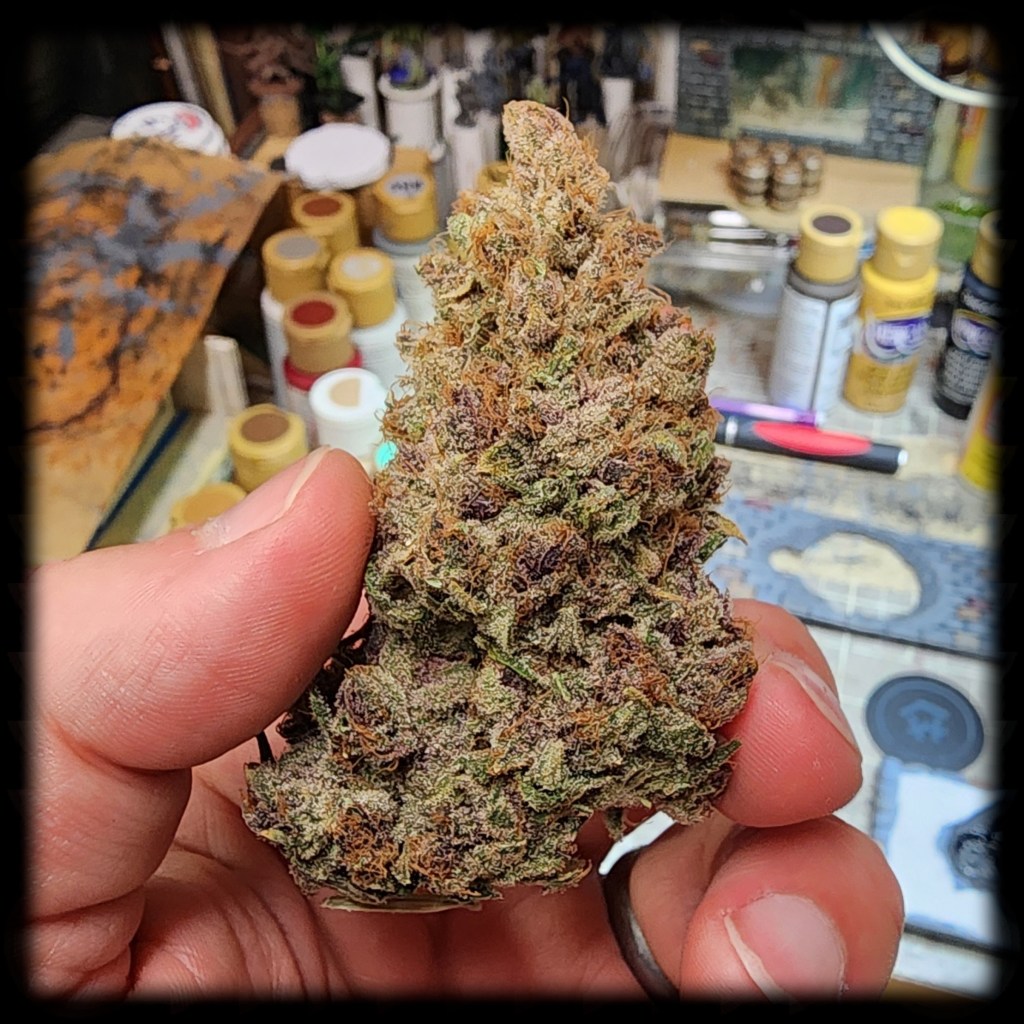
The aroma is similar to what I was expecting after having the cart, with some subtle additions. It still carried the overwhelming sense of its namesake fruits, though I’d swap the grapefruit descriptor for something more like guava, but the banana layer added a creaminess that was reminiscent of a smoothie. But the light earthy quality came forward a bit more as well, defining itself more specifically as a gentle coffee background, giving the whole experience the feel of getting a smoothie at a coffee shop. The drink may not smell like it, but it’s ever present in the background.
The smoke was quite nice, medium-bodied, smooth and buttery, with just a bit of a tingle in the throat. Much of the sweeter notes from the aroma dropped off, leaving the smoke tasting of banana and more chocolate than coffee. Funny that it smells like one smoothie, and tastes like another. But even with the undertone of bitterness and pungence, it was still a tasty smoke.
The high is more or less the same as the cart, though I was smoking this later in the evening, and in a more sedentary context, sitting on the couch and watching – I believe – Rings of Power (the Lord of the Rings show, which should be no surprise that I am watching, as I did those two LotR posts a few months back). So I felt the body high a bit more, but this was still not at all a heavy or sedative strain. It’s an excellent hybrid, worthy of its lineage which includes Tropicana Cookies and Strawnana, which itself is a hybrid of Banana Kush and Strawberry (which in turn is a phenotype of Bubblegum).
Notes – Flower
Context
Solo
Evening
At Home
Appearance
Medium Green
Bright Green
Dark Green
Purple
Orange Hairs
Frosty
Fluffy
Large Nugs
Texture
Sticky
Soft
Aroma
Banana
Strawberry
Guava
Coffee
Flavors
Banana
Chocolate
Bitter
Pungent
Smoke
Buttery
Medium
Smooth
Spicy
Head High
Euphoric
Stoned
Fuzzy
Calm
Other Effects
Calm Body
Tingly
Hungry
Thirsty
Dry Eyes
Notes
Context
Afternoon
Solo
In public
Appearance
Medium Gold
Clear
Texture
N/A
Aroma
Fruit
Sweet
Flavors
Strawberry
Grapefruit
Banana
Vapor
Clean
Medium
Smooth
Head High
Uplifting
Energizing
Other Effects
Calm Body
Digestive Relief
Dry Eyes
Dry Mouth
 Stoned Coast