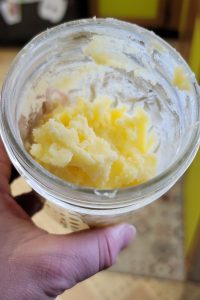
Has the idea of making your own edibles at home seemed out of reach, just too complicated, or too messy? Double boiling ounces and ounces of cannabis, straining, pressure-cooking, and hours of work? With the increased accessibility of high quality concentrates, making your own edibles has become super easy, quick, and affordable.
This recipe is really more of a general how-to. There’s no additional recipe for what to do with the cannabutter once you’ve made it, but you can always refer back to any of my recipes for ideas, or you can generally substitute cannabutter for regular butter (or canna-oil for regular oil) in most normal recipes.
There are two “Instructions” sections below. The first is the math for figuring out how much to make, how much cannabis concentrate and butter/oil to use, and how to determine and measure your doses. If you haven’t had a “too much edibles” experience, count yourself as lucky. Overdoing it with edibles can be less than pleasant, and I’ll be adding a more detailed guide for dosing and edibles strategies so keep an eye out for that on this site, but for now, the general rule is “Start Low, Go Slow.” It takes about an hour on average for edibles to kick in, so be patient.
The second “Instructions” section is for the decarbing and infusing, actually making the cannabutter/oil. The reason for heating concentrates is somewhat complex on a chemical level, assuming you’re not already a chemist. But the quick breakdown is this: The THC in raw cannabis plants and concentrates is actually THCA, or tetrahydrocannabolic acid. THCA has some benefits and effects, but not the pure psychotropic feel of THC. Heating THCA just the right amount converts it to tetrahydrocannabinol, or what we generally just call THC. This process is called decarboxylation, sometimes referred to as “decarbing.”
So, sit back; light up a joint, do a dab, or puff that vape; and enjoy how easy it is to make quality, safe, and easy cannabis-infused edibles in the comfort of your own home. (That being said, if you are going to be using cannabis while doing this, please be extra responsible. You’re dealing with heat, timing, and math, so plan accordingly.)
Cannabis Ingredients:
- Cannabis Concentrate
Non-Cannabis Ingredients:
- Butter, Coconut Oil, Vegetable Oil, etc.
Gadgets:
- Oven and Stovetop
- Baking Sheet Pan
- Parchment, silicone baking sheet, or silicone baking cup
- Small Spatula (silicone)
- Small or Medium-sized Sauce Pan
- Whisk
- Jar, Silicone Mold, or some other container for cooling or storing the butter or oil if you’re not using it immediately.
Dosing Instructions (The Math):
Let’s make some assumptions about a hypothetical example recipe:
- We want 10mg doses of THC per serving, as that is a generally accepted “normal dose” for most people.
- Our concentrate is 70% THC, which is in the normal range for quality full spectrum concentrates.
- We’re making a recipe that can be divided into servings with relative ease, like cookies or brownies, not like – for instance – beef chili.
The first is determining how many milligrams of THC you have to work with. As many concentrates are sold in 1 gram amounts, usually this is easy. 1 gram is 1000 milligrams, so our 70% concentrate has 700mg of THC, or:
[1 gram weight of concentrate x 1000] x [70% -OR- .70] = 700 total milligrams of THC
If you’re working with more than one concentrate and they are different percentages of THC, then repeat that math for each concentrate and add them all up.
Now that we know we have 700mg of THC, we want to figure out how much butter or oil we want. If that 700mg is what we want for the whole recipe, then it’s as easy as using as much butter/oil as the recipe calls for. If this is for a batch of cookies, and I can get 70 cookies out of it, then that’s easy, as that 700 divides into 70 cookies, getting us 10mg cookies. But let’s say this is for a batch of brownies that we want to cut into 16 brownies, each with 10mg. We’re going to infuse all of this concentrate, but we’ll only need (16 x 10 = 160) 160mg of THC out of that 700mg.
Recipes (at least in the U.S. where we use the Imperial system of measurements) generally measure fats in tablespoons or cups. With 16 tablespoons in a cup, but many recipes calling for 1/3’s of cups, deciding how much THC you want per what amount of butter/oil can be tricky since 16 doesn’t divide evenly into 3. You could, in this case, find a common number that divides into both, such as: 16 x 3 = 48. Then to increase that to a more workable number we just multiply it by 10, to get 480mg THC per cup. This way, we could get any evenly measured amount pretty easily. 1 cup = 480mg; 1/3 cup = 160mg; 1/4 cup = 120mg, 1/16 cup (or 1 tablespoon) = 30mg. (And, for what it’s worth, there are 3 teaspoons in a tablespoon, so even a single teaspoon is 10mg.) So, no matter the measurement, we can find amounts of butter/oil that have an amount of THC divisible by 10.
For our cookies/butter example, let’s say the recipe calls for 1 cup (16 tablespoons) of butter. We’ve already determined that we’re using all the concentrate to get the 10mg servings that we want, so our ingredient list is our 1g of concentrate and 1 cup (16 tablespoons, or 2 sticks) of butter.
For our brownies though, we have to do some math. Let’s say we’re keeping this one easy and we’re using a box mix that calls for 1/3 cup of oil for the whole recipe. We’ll need to figure out how to get 160mg of THC per 1/3 cup. Using the suggested option above of 480mg per cup, now we need to figure out how to get 700 into that. 700 ÷ 480 = 1.458333, so again, we have a difficult number.
Here’s where rounding becomes pretty necessary, and why on a lot of professionally produced cannabis edibles the front of the package says “10mg per Serving”, but the sticker on the back with all the technical information usually has a number specific to that batch but close to 10, like “9.61mg per Serving” as an example.
So, not only do we need to do some rounding of numbers, but it’s safe to say that rounding here is a pretty standard practice. I won’t hash out all the math I did on the side to determine how much I needed to round here, but it comes down to simply rounding 1.458333 to 1.5. I’d hoped there was something a tiny bit closer, but I advise you to round the amount of butter/oil up and not down, so that your doses will be a tiny bit lower rather than higher.
So, we want to infuse our 700mg THC concentrate into 1.5 cups of butter or oil, so that we can use 1/3 cup to get almost exactly the 160mg that we wanted in 1/3 cup.
At this point you may be feeling like this is really tedious and unnecessary, but if you don’t have one of those stories that starts with “I did too much edibles that one time…” or “my friend made some brownies and we had NO IDEA how much weed was in them!” then count yourself lucky. Overdoing it on edibles can be really rough. As I said in the intro, this deserves its own post, and so it will get one in the future, but edibles tolerances are not tied to your experience smoking cannabis, and can be wildly unpredictable the first couple of times for some people. Learning about your personal tolerance and dosing needs for edibles is really important for your general well-being, but also your ability to enjoy the high that can come from edibles. Remember, they generally take up to an hour to kick in, but they also tend to last a lot longer than a few puffs of a joint, like up to 4 or 5 hours. For real, I’ll do at least one dedicated post to this in the future, but for now, start around 2mg of THC in an edible, give it an hour, and then slowly increase from there.
So, that’s the Math. On to the process itself.
Recipe/Decarbing Instructions:
- Preheat oven to 220°F.
- Get the concentrate into the baking cup or onto the mat/parchment. This can be tricky, depending on the form of the concentrate and the container it comes in. I love working with shatter, as it’s fairly solid and you can usually just pop it out of its package onto or into the baking sheet/cup. If you’ve got a more saucy concentrate and it comes in a ceramic or glass puck (container), you can put that on the baking sheet in the oven for a few seconds at a time, and the concentrate should be easier to scrape out with a small silicone spatula before the container gets too hot to handle safely. As long as you can get it all cleanly out of the container and into/onto the cup/mat/parchment, that’s all you need.
- Put the concentrate in the oven, close to the middle, but you’ll want to be able to check it easily, so wherever you have a good view is fine. Feel free to obsessively check it throughout the next step.
- While the concentrate is in the oven, melt your butter or heat up your oil in a pot on the stovetop. You don’t need it very hot, just warm enough to be able to incorporate the concentrate evenly. If it doesn’t mix in evenly, your dosing will be variable and inaccurate.
- Back to the concentrate in the oven. What you’re looking for after 15 minutes or so is bubbles. The concentrate should lightly bubble. If you have a candy thermometer, you can check the temperature. The concentrate should hit 200° and stay there for 10 minutes or so. Again, overheating it will burn off the THC, but too little won’t activate it. I find that about 30-40 minutes in the oven total does the job.
- Once the concentrate is ready, you want to get it into the warm (but not hot) fat – be it butter or coconut oil or whatever you’re using – as quickly as you can to make sure it doesn’t cool and stick. Once it’s in the fat, stir with a whisk until it’s entirely incorporated. As long as the fat isn’t too hot, you can do this for as long as you need to get it evenly mixed, so feel free to take your time here. If it’s too hot, you risk losing THC, but you want it warm enough that you can keep stirring it evenly.
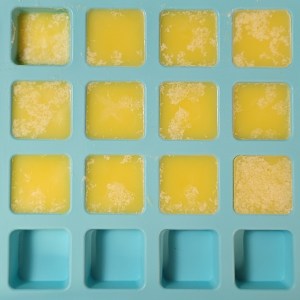
- When you’re satisfied that it’s evenly distributed, you’ll likely need to bring the butter or oil back to room temperature or even get it chilled, depending on when you’re using it and what the recipe calls for. You can do this in any appropriate container. If you know you’re using the whole amount and you won’t need to re-measure it, I find that a mason jar or glass measuring cup (like Pyrex) works just fine. If you want smaller, pre-measured volumes, a silicone mold like you might use for making chocolates or ice cubes works really well. These molds also come in countless designs, if you were making this for gifts or to show off. I should have used one of my cute molds for photos for this. Next time…
Once that’s all done, you can use this butter or oil as normal in your recipes. Or just put it on bread. Or whatever. Just keep in mind your dosing needs.
Notes:


Leave a comment