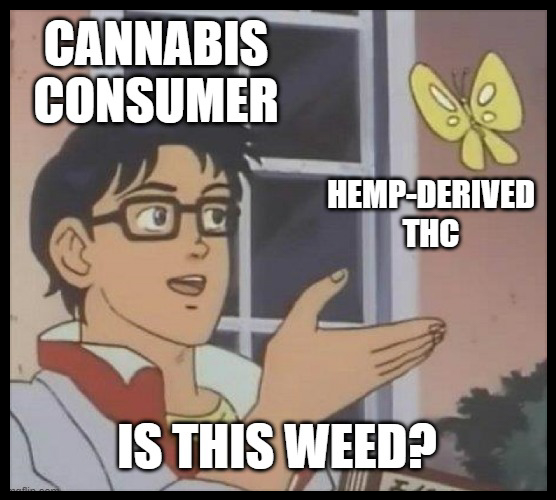
I’ve found that I’m repeating myself a lot at work, particularly this one controlled rant that I’ve issued enough times that it’s nearly identical from one instance to another now. It goes something like this:
“Do you mind if I give my little rant about this?” Customers are generally excited, so they say yes. “Excellent. The 2018 Federal Farm Bill that codified the laws and regulations around hemp nationwide set the definition of hemp as basically just cannabis that’s under .3% THC, and that’s the same delta-9 THC that’s in regular cannabis.” 1, 2
I then gesture to all the products around us.
“Now, that’s meant as .3% of the dry weight of the hemp flower, which isn’t enough to get you high, even if you smoked a ton of hemp. But there’s this giant loophole that some clever people and companies have started exploiting, especially over the last year or so. You can basically stripmine the hemp for that tiny amount of THC, but do that in a high enough volume and you end up with enough THC concentrate that you can now make edibles or drinks with it. Or you can just spray it back onto other hemp flower until you’ve got fifteen, twenty, thirty percent THC hemp? And if hemp is just low THC cannabis, then what you’ve got now is…”

At which point I usually trail off, hands extending palms up, out toward my audience, inviting them to finish my sentence. Which they almost always do, with whatever word they like to use for cannabis: weed, pot, marijuana, whatever.
“Except that it’s all hemp-derived, so unless a state wants to regulate it separately, it’s not covered under cannabis laws. It’s basically unregulated, at least as far as quality and safety requirements and retail sales are concerned. If a state doesn’t have a law restricting it, you can sell it in gas stations and convenience stores. You could sell it at a grocery store, or serve it at a bar. See, at least here in Maine, you can’t sell THC and alcohol in the same product, or the same store for that matter, even if they’re separate products. But hemp gets around this too.”

This is usually where the now-semi-scripted rant may break down a bit, since customers are almost always taking part in what is turning into a conversation, but I make sure to get in my one last point, though this is less polished, since it’s been worked in differently each time:
“And while I’d like to think that I’d feel this way even if I weren’t a parent of middle school kids, the lack of regulations means that unless a specific company or store chooses to card for these products, my kids could walk into a gas station and buy, what, 100mg of THC beverages, legally? My 13 year-old can’t buy a beer, or cigarettes, or walk into a dispensary and buy a joint, and for a good reason. Add to this, even if that’s not your concern, this is messing with the legal cannabis industry. What’s the point of all this,” as I gesture around again, “if you can just sidestep the rules that allow us to do what we’re doing right now, and sell what amounts to the same product, anywhere to anyone? Without safety regulations or standards for testing or packaging or labelling, you might also be used to say a 5mg drink, so that’s the hemp-derived dose you buy. But maybe it’s inaccurately labelled, and now you’re freaking out because you’re way too high, and it turns you off of a product you were getting here, in a legal and legit cannabis retailer. Or maybe it’s full of pesticides, or mold, and you get sick. Either way, it ruins your experience, and it hurts the legal cannabis business. No one wins except the hemp-derived people’s bank accounts.
“Rant over. Thank you for coming to my TEDtalk.”
Laughter ensues. While I get pretty heated about this topic, I want my customers to feel okay about continuing to use the good stuff. I just want people to understand why this whole hemp-derived THC thing is so concerning, and frankly, quite infuriating.
And don’t get me wrong, I’m not against the thing existing, conceptually. I’m a big fan of hemp. I take a full spectrum CBD supplement every day. But this hemp-derived THC is nothing more than people trying to get around cannabis laws and regulations, no matter what they say about ‘access’ or ‘medicine’ or whatever. If that were the case, you’d only see these products in states with no cannabis access at all. If this is in a state – like Maine – that has an accessible recreational and medical market, then there’s no need for hemp-derived THC products in our state. Honestly, as a means of fighting the ignorance that some people violently cling to concerning cannabis, if this were some “damn the man” thing being done only in states where cannabis access was restricted to the point where there wasn’t even medical, then I could get behind it, but only as a step toward proving that those states (there are only – I believe – four of them) need some form of regulated access for cannabis products.3
For what it’s worth, there are groups inside and outside of the government who are working on closing this loophole, both at the federal and state levels, but currently there are only a few states that have laws on the books regulating hemp-derived THC.4 Maine has a working group of health professionals and cannabis/hemp industry producers who have proposed age limits and THC potency caps for hemp products, but even within that group, at least one of the members has been quoted, saying that they believe hemp-derived THC should be limited to 21+, but they also produce hemp-derived THC beverages and sell them to non-cannabis businesses, relying on those businesses to card their customers.5

There are also bars and breweries in the area that are pouring hemp-derived THC-infused drinks for customers to consume on-site, while some in the legit cannabis market are trying desperately to get legislation that would allow for social smoking clubs, or some amount of on-site use at dispensaries, even if that’s not smoking specifically.6 I’m not about making enemies, but I find it insanely hypocritical, or at least irresponsibly selfish to skirt the regulations for an easy buck, when there’s already a safe and legal way to get these products.
At the federal level, the 2018 Farm Bill was set to expire in 2023. As Congress was working on legislation to renew the bill, Maine’s own Rep. Chellie Pingree introduced an amendment that would have closed these loopholes. Unfortunately the can was kicked down the road, and the 2018 bill was extended until this year, 2025.7 Hopefully the amendment will be adopted this time around and we’ll see this loophole closed at the federal level, so that it doesn’t add one more layer of cannabis laws being different from state to state. And just to state clearly how non-partisan an issue this is, the original 2018 Farm Bill was proposed by then Republican Senate Majority Leader Mitch McConnell, who stated “everybody has figured it out that this isn’t the other plant.” 8 I’ve said it before, and I’m sure I’ll say it again, cannabis is the great equalizer, the thing that bridges more social divides than just about anything else.
Beyond drinkables (and presumably other edibles) being sold locally, this loophole at the federal level has also opened up an online cannabis industry through the sale of hemp-derived-THC-infused hemp flower (as I alluded to in the opening paragraph of my rant). Being sold as “legal cannabis” (as the other thing the Farm Bill did to define hemp was to acknowledge that it’s a variant of cannabis sativa), we’re seeing companies – many of them celebrity-backed – marketing this infused hemp as weed… because it basically is. I never thought I’d have beef with Snoop, or Seth Rogan, or Cheech and Chong, but they’re all selling infused hemp as cannabis, as well as vapes and edibles and the like, all online. Don’t give them your business, please. Shop local, and legit, because, again, there are no regulations that ensure you’re getting a safe or accurately labelled product.
I could keep going, as my regular readers and customers know, but I feel like this is a solid overview of what’s going on with all this hemp-derived THC. If anyone has questions, or requests, for ways to do a deeper dive into this topic, please let me know. For the time being, I’ve not only linked my annotations below, but I’m including additional resources about this issue if you’d like more reading on this topic.9, 10 Like I’ve said a couple times now, this issue has me pretty elevated, so I’m happy to keep researching and ranting. I’ll be back next week with a review. Until then (and always), keep supporting your local and legit cannabis retailers.
References
- https://www.usda.gov/farming-and-ranching/farm-bill (This is a summary of the Farm Bill)
- https://www.congress.gov/bill/115th-congress/house-bill/2/text (This is the full text of the Farm Bill. The definition of hemp coincidentally begins on pg. 419 of this document. Someone must have known…)
- https://disa.com/marijuana-legality-by-state
- https://www.cannabisbusinesstimes.com/hemp-derived-cannabinoids/news/15686899/hempderived-delta9-thc-whats-next#:~:text=State%20Legality%20of%20Hemp%2DDerived,THC%20products%2C%20with%20mixed%20results:
- https://www.pressherald.com/2025/02/02/working-group-recommends-regulating-intoxicating-hemp/
- https://www.pressherald.com/2025/02/25/maine-inches-toward-allowing-cannabis-social-clubs/
- https://kffhealthnews.org/news/article/hemp-delta-9-thc-products-legal-questions/
- https://www.usatoday.com/story/news/health/2022/10/29/hemp-delta-9-thc-regulation-explained/10595313002/
- https://www.npr.org/2025/01/10/nx-s1-5220336/despite-strict-laws-texas-is-awash-in-intoxicating-cannabis
- https://pmc.ncbi.nlm.nih.gov/articles/PMC10406389/#:~:text=A%20federal%20policy%20loophole%20allows,recreational%20cannabis%20is%20not%20legal.
 Stoned Coast