Indica
High THC (>30%)
Flower
The single most surprising thing I learned upon beginning my journey as a budtender was the stark difference in Maine between recreational cannabis – referred to as Adult Use (AU) in all the laws and statutes – and medical cannabis. When asking the average person about what they think the difference is, most say something like:
“Medical is stronger, right?”
And if one were to casually peruse listings for medical vs. recreation online, it’s super easy to see why that perception exists. I’ve seen some medical shops with not a single listing below 28% THC, with many or most strains topping 30%. And while we haven’t had the kind of scandal that hit California concerning impossibly inflated numbers (science seems to agree that it seems unlikely that a cannabis plant can even grow to be above approximately 34% at all), it certainly could seem odd that all these med growers are consistently pushing the upward limits of THC while even the most excellent of rec cultivators have much more variability in their numbers.
Which brings me to my point. Almost. I do want to add the disclaimer that I am speaking about laws and regulations, and I am making some broad and general statements about medical vs AU cannabis in Maine, but it could come across as an attack on the medical cannabis market and cultivators, and I want to state clearly that there are many excellent medical brands here in the Maine that have elevated themselves by adhering to higher standards than the law requires.
Which actually brings me to my point. For the consumer, the single largest difference between medical and adult use cannabis in Maine is that there are strict testing requirements for AU, checking for:
- Filth and foreign materials
- Dangerous molds and mildews
- Harmful microbes
- THC potency, homogeneity and cannabinoid profiles
- Water activity and moisture content
- Other harmful chemicals (metals, including cadmium, lead, arsenic, and mercury)
- Residual solvents
Adult Use cannabis in Maine cannot go to market if there are any of the above contaminants, and THC must be reported accurately as well.
These are not required tests for medical cannabis in Maine, though. I usually only drop this information in three situations when I’m budtending: if the customer specifically asks what the differences – if any – are between the two, if the customer and I are just getting into a deep conversation about cannabis generally and this is where it leads organically, or if I’m trying to salvage a customer experience that is not going well because they are tenaciously clinging to the idea that medical is “better” or “stronger” or they are expressing their intent to not purchase anything because they can get an ounce of whatever at a med shop for $50. This is when I find it helpful to inform them about the lack of testing.
Sometimes it’s important to that customer that they know their cannabis is clean, and they should know that there’s no requirement to test for molds or pesticides or harmful chemicals. Sometimes, if they’ve already brought up the potency issue, it’s important for them to know that a medical cultivator or dispensary could be simply making up their THC percentages, where as the cannabis they’re looking at in my budbar has been tested, and the THC percentages I’m presenting are accurate.
As I said above, there are good medical growers out there who choose to test their product, even to recreational standards, and who disclose upfront that information, even if that simply means accurate THC in their listings. The Maine Office of Cannabis Policy (OCP) – the state agency overseeing all of this – even published their own single page quick guide called Understanding Cannabis Testing Requirements & Results in Maine, which recommends asking your medical budtender or caregiver for testing results, and if they do not test, possibly seeking a dispensary or caregiver who does. I’ll provide links to all of this at the bottom of the post.
So, why am I talking about all this? Well, my review this week is the first cultivation I’ll have written about that is 100% from the medical market. Some of the growers I like and have reviewed are still players in medical cannabis, but they also sell recreational, which is what I’ve been selling and smoking and writing about. Since I started budtending, I’ve basically consumed strictly recreational cannabis, with the occasional joint here or there from medical, usually shared by a friend, so when I came into possession of three nice looking nugs of different strains from The Pot Stop, I thought it would be a perfect opportunity to try some med weed, and to write about it, assuming that I had nice things to say, which I do.
This week I’ve got some Obama Runtz, hilariously topical, as the day this posts is the Monday following the 2024 Republican National Convention, and the announcement by President Biden that he won’t be seeking reelection afterall and has endorsed Vice President Harris, so there’s a lot going on. But I won’t be getting into these kinds of politics here on my blog, and I ask everyone who reads to please do the same.
But I couldn’t help myself…

Doing a bit of digging, this strain was cultivated for The Pot Stop by Cannabis Culture Co, which as far as I can tell from their web presence, are the same company? It looks like The Pot Stop is just the storefront name, and Cannabis Culture Co. is their cultivation name, as they also sell wholesale. If I’m wrong and someone reading this can correct me, please do so. Speaking of testing, for the sake of transparency, they claim on their website that their products are all tested for many of the above listed items, including THC, but their testing is done by ProVerde Labs, which doesn’t seem to be one of the approved Maine testing labs, and is in fact in Massachusetts. I’m not sure how that works, since THC products aren’t supposed to be transported across state lines, as I understand it. Honestly, I don’t know what to make of any of this. I’ll be looking into it some more and I’ll add any updates to future med-related posts.
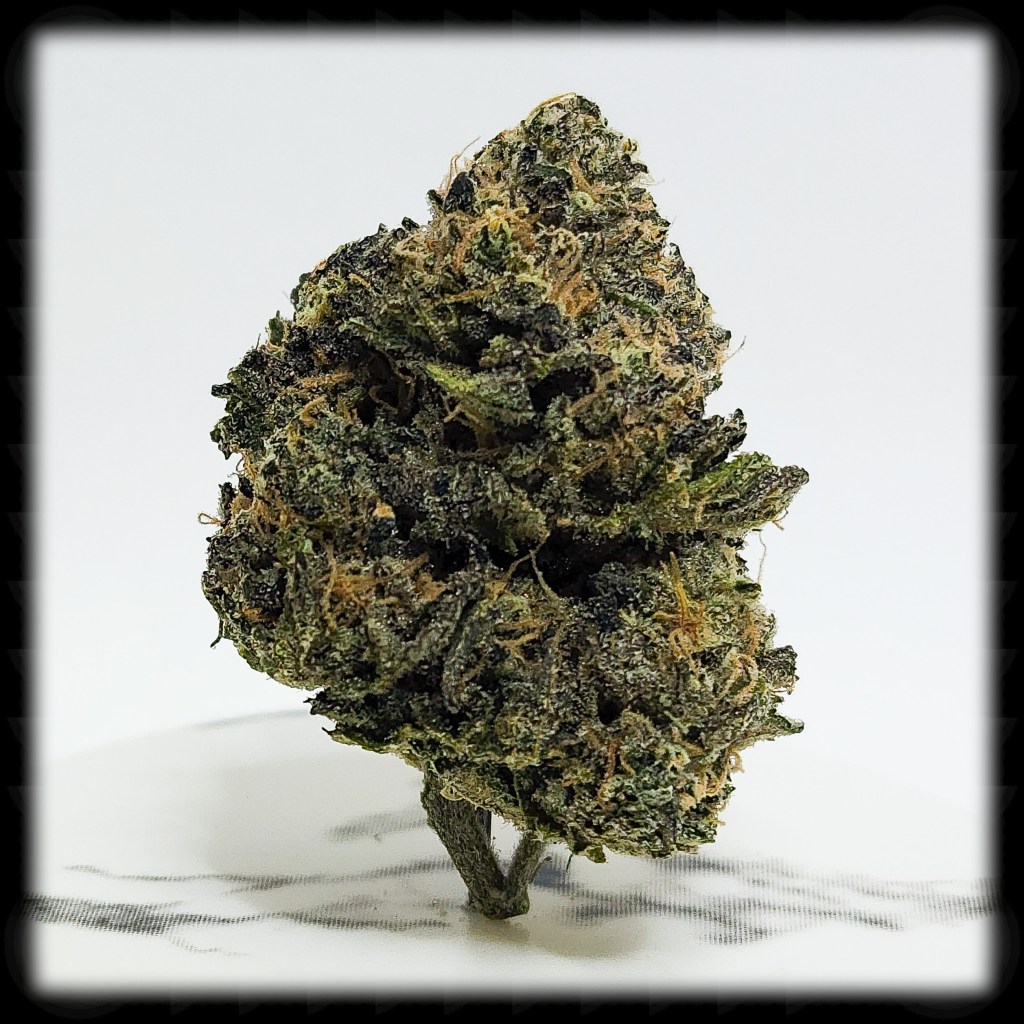
The flower itself was pretty good. It has one of the classic indica looks: pale to dark greens, small clusters of tendrily brown pistils, and fairly frosty with trichomes. The single nug that I had was a chunky medium size, with that dusty/dry texture, and a densely spongy feel. I had a consultant on the aroma, as I love to share, even with those who don’t smoke, and we both got a sense of old lacquered wood. I also had the sense of a rich coffee overtone, with floral and musky earthy notes beneath. For those who grew up in and around Portland and remember Java Joe’s on Exchange Street in the Old Port, that was what the aroma took me back to. It’s the smell of a pre-trendy cafe in an old building, well-maintained and clean, but the kind of place where you can smell the history beneath the fresh and rich coffee aromas.
The flavor of the smoke carried much of the aroma, but severely blunted and quite a bit bitter. Strangely, the bitterness that naturally comes from smoking flower from a bowl or bubbler frequently increases as you’re smoking, as you’re burning through more ash on top, and as the biological material carbonizes more and more. But strangely, it was the first couple of hits that were the most bitter, and while it still maintained that as the forward-most aspect of the flavor profile, it did allow for a bit more of the coffee, wood, and muskiness to come through after those initial hits. Otherwise, the quality of the smoke was relatively harsh and heavy, like trying to inhale velvet (not through velvet, but inhaling velvet itself), with a spicy, tingly throat-feel. If not for the high, I might go so far as to say that I didn’t enjoy smoking this flower, despite the very lovely and comforting aroma. As a note, this was all from my normal bubbler, which I’ve mentioned before.
But that aforementioned high was quite excellent overall, if not a bit unexpected in some ways. The head high was stoney, almost heavy, but very calming and thought-provoking at the same time. While I was not in a particularly social setting when smoking Obama Runtz, it would be an excellent high for one of those stupidly deep conversations with close friends about some bizarre and esoteric topic, like how spacetime explains the existence of ghosts, or how souls are just another form of energy neither created nor destroyed but instead part of a vast pool from which new souls emerge as simply a hodgepodge of aspects drawn from that energy source. You know, everyday stuff that everyone talks about.
The body high was the more unexpected part though. I hesitate to say that it had the opposite effect of pain relief, as that could very well be construed as it causing pain. But what it did was heighten my sense of touch, making me feel more sensitive to that form of sensory input. In my case, since I suffer from some chronic pain due to arthritis and other related issues, those aching bits did ache just a bit more than before, but otherwise the body high was calming and a little heavy, and my stomach felt very settled without any heavy munchies (to which I am prone to begin with).
All in all, I mostly enjoyed this strain, despite the somewhat minor complaints. I’ll be exploring more of these medical cultivations in the coming weeks, and I’m really interested to see if there are similarities, especially as the three that I currently have are all from the same shop, and I think all grown by Cannabis Culture Co. Again, updates as I learn more. As always, thanks for reading!
Links, as promised:
Required Analyte Types for Mandatory Testing on Maine.gov
Maine OCP Testing of Medical Cannabis Products Results
Notes
Context
Evening
Solo
At Home
Appearance
Dark Green
Pale Green
Brown Hairs
Frosty
Dense
Medium Nugs
Regularly-Shaped Nugs
Texture
Dry
Dusty
Spongy
Aroma
Coffee
Wood
Floral
Earth
Musky
Flavors
Bitter
Coffee
Wood
Musky
Smoke
Harsh
Heavy
Spicy
Velvety
Head High
Stoned
Thoughtful
Calm
Euphoric
Other Effects
Calm
Tingly
Heavy
Digestive Relief
Dry Eyes
 Stoned Coast
Leave a comment