Hemp
Very Low THC (<10%), High CBD, High CBG
Flower
Happy belated Father’s Day to you all, especially you dads out there in whatever form your dad-ness takes. I have all those cats in addition to my human children; I get it, we come in all shapes and sizes. Speaking of shapes, I’m glad “dad bod” is no longer everywhere all the time now. On the one hand, sure, it was nice seeing Leonardo DiCaprio with a bit of a tummy, but on the other hand, I’m sure many of us did NOT need an excuse to let ourselves go. More than we had already. I’m sure if Brad Pitt had to put on a few pounds for a role as a normal human being in some movie, his doctor wouldn’t be as worried about his blood sugar or the wear and tear on his joints as my doctors are about normally.
To honor this day where we celebrate diner breakfasts and rib dinners (my two favorite long-running traditions, though charcuterie has snuck its way in in the last few years, and I’m digging that too quite a bit), I thought I’d take a look at this thing called “dad weed” and then give my review of the daddest of weed: hemp.
So, what is “dad weed” and why do I keep using quotation marks? Unlike some slang terms in cannabis culture that have specific meanings (zip for an ounce, slice for an 1/8th), a lot of terms for types of weed are a bit less consistent. “Chronic” generally refers to really good weed, but there are some that intend something more narrow, like high THC, if they’re going to use the word. Dad weed (I’m dropping the quotation marks now) is less specific in general, but is a way to refer to cannabis that is either reminiscent of old school weed from before professional, legal cultivation (roughly early 2000’s or older), or that specifically has very low THC or higher non-THC cannabinoids like CDB, CDG, and the like, in addition to a more contemporarily normal amount of THC.
Why the shift in THC levels over the last 30 or so years? Despite cannabis having been used by humans for many thousands of years – perhaps even tens of thousands or more – we only isolated the CBD molecule in 1940 and the THC molecule in 1964. So as of the mid-60’s we’ve known the exact chemical that is the primary agent in cannabis for the psychotropic effects. Suddenly we had a quantifiable measurement for the potency of weed. Not fully (or perhaps at all) understanding the need for the other cannabinoids and terpenes for the full host of effects, many cultivators of cannabis over the decades since have bred for that one thing: THC. This has led to so many users completely misunderstanding what it is they do or do not want their cannabis to be, and has led some growers to engage in practices that have actually created lower quality products.
I’ve seen this personally with customers who, when asked what they’re looking for, begin their answer with “I don’t want any CBD in my weed,” when there is some amount of CBD in all cannabis, and many of these customers are confused when I try to explain that. They thought CBD was something added to their weed, and worse than that, they thought it was responsible for less potent weed.
There are also stories of massively inflated THC percentages by means of spraying plants with THC distillate (basically close-to-pure THC) to increase the test results. There was a scandal in California not that long ago surrounding this practice, and coincidentally not long after, customers seem less likely to ask for cannabis that’s “at least 40%,” which I was hearing a lot before that story broke.
As a side note on this point, there seems to be some evidence that the hard cap on the percentage of THC naturally occurring in cannabis may be around 34%. This is a wiggly number, as this requires actually cultivating the flower at higher and higher percentages, which is an imperfect practice. Additionally, the number we use for THC% is derived from the actual THCa which is in the plant before it is decarboxylated (smoked) and converted to THC, the actual THCa% is variable throughout the plant (some parts of the plant are heavier in THCa and other cannabinoids than others), AND this percentage is representative of the total weight of the plant after it has been cured (dried) which also changes the chemical makeup. But still, it seems terribly unlikely that there is weed out there on average across a fair sampling of the whole plant actually testing at well over 40%.
But why do we call this old school, low THC cannabis dad weed? The clearest means to an answer here is that dads are old and this weed is old. Laugh it up, you whippersnappers. And get off my lawn while you’re at it. I don’t need to hear your rock music and Tik Toks.
(Oh no. Now I want to start referring to plural Tik Tok vidoes as “Tiks Tok,” like brothers-in-law, or attorneys general… Most of my coworkers are going to hate it. The others are a dad, and a dad-adjacent)
The other reason behind the term dad weed – the one that I really like – is that due to low THC, or balanced cannabinoid profiles, or whatever other similar quality may put a strain into this category, dad weed is more relaxed, less debilitating in the head high, and typically more therapeutic than more modern styles of cultivations that are aiming for as big a high as possible. It will come as no surprise to my regular readers that I really like subtle highs, balanced highs, mellow highs. I’ve written before that some of my very favorite strains have tested below 15% THC, one as low as about 5%. The average THC of cannabis before the boom of legalization in the US seems to have been in this sub-5% range, with much of the time between 1964 and the turn of the millennium finding weed to average 2-3% THC.
Look, I’ve got kids that might wake up and need me for something, and my back and knees hurt from yardwork, and I can’t be all weed-hung-over tomorrow because I have to be up early for work. Dad weed.
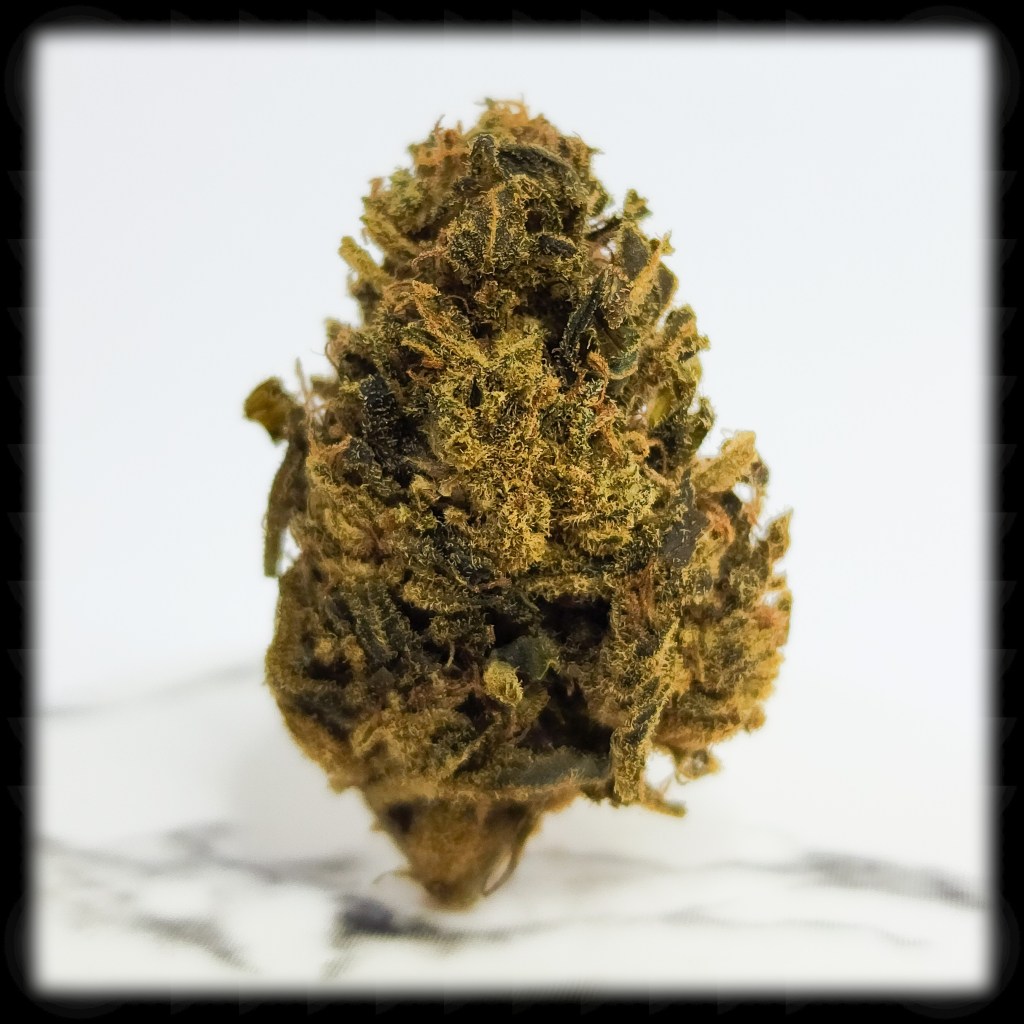
This brings me to the review this week, Hawaiian Haze hemp. That’s right, I’m reviewing something that’s not technically cannabis, such as we think of it. I’ve been smoking hemp, and my favorite strain of hemp too, as it’s the strain that I take in a tincture every morning to help with inflammation and pain (specifically from my arthritis). This is the first time I’ve purchased the flower though, and while I’ve been mixing it with other cannabis flower to heighten the body effects of whatever strain I’m using to get high, I’ve also been smoking it straight, and it is really nice.
The buds themselves – as the plant is structurally the same type of plant as traditional cannabis – look right at home in my gallery of cultivars. They’re soft, almost spongy, with a range of greens from medium to dark, almost black sugar leaves lightly peppered throughout, and with orange pistils that could almost be called bright. There’s a gentle stickiness to their texture, and they pull apart easily, though they are sort of sticky in the grinder, so be forewarned. The aroma is a real Goldilocks: not too strong and not too light. There are sweet notes of tea, wood, and lemon, with a hint of floral richness beneath.
The smoke was surprisingly gentle for how sticky the buds were. I feared that what seemed like a less cured flower would result (as it frequently does) in smokier and more acrid hits, but I was happy to be proven wrong. They were easy, and light, with a bit of a spicy texture about the edges. The flavor was almost entirely different from the aroma, which I always find exceptionally interesting. There was still a woody tone that carried through, but the smoke tasted very subtly of sour tropical herbs and just a touch of diesel.
The effects, as would be expected, were far less obvious than cannabis highs, at least for the head high. And in fairness, I wasn’t expecting a terribly big head high, as hemp in the US must be under 0.3% THC, so we’re talking really low even for someone who likes low THC weed. I found my brain mostly calmed, with a bit of focused thoughtfulness sprinkled in, which certainly helped with my notes and drafting of this piece. The body high, which is what I came here for, was very nice. I am still (again?) dealing with some spinal issues, but this time it hit me between the shoulder blades, which is not where I am normally dealing with this type of pain and discomfort, but the pain there went from two acute and intense spots to a more broad and dull ache across the stretch between the two points. Not complete pain relief, but enough to ease things while I sat down to type. I also felt it in my guts, where everything settled really easily (after eating ribs the day before).
All in all, I really enjoy having hemp as part of my rotation, both as a tool to use on its own, and as means to supplement strains of cannabis to bring in better body effects, or to simply balance a strain a bit more if it’s very heavily THC-leaning.
Notes
Context
Early Morning
Solo
At Home
Appearance
Medium Green
Dark Green
Orange Hairs
Dark Purple
Fluffy
Medium Nugs
Texture
Sticky
Spongy
Aroma
Sweet
Tea
Wood
Lemon
Floral
Flavors
Wood
Sour
Tropical
Diesel
Smoke
Easy
Light
Spicy
Head High
Calm
Thoughtful
Focused
Other Effects
Calm Body
Pain Relief
Digestive Relief
 Stoned Coast
Thanks for the tips! By the way, if anyone is in London, Ontario, you can get weed delivery London Ontario same day.
LikeLike